

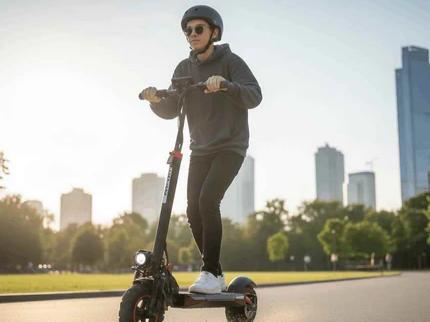
Getting around a city shouldn’t hurt your feet or your ride-share bill. An adult scooter changes everything about getting around airports, neighborhoods, and a city.
The Weight-Range Sweet Spot
Most folks are hoping for a scooter that weighs between 25 and 35 pounds and can go about 15 to 25 miles on a single charge. Why does that work best? It is fantastic to have a single battery that lasts all day, but it is not the best option for walking upstairs.
Leaving enough wiggle room, it accounts for airport transfers between hotels, meetings, and evenings out on the town. Lithium-ion batteries have a better range and are smaller, so a 30-pound scooter can go as far as a 40-pound scooter from five years ago.
Scooters weighing less than 25 pounds offer too little range to be practical to ride every day. Scooters weighing above 35 pounds become cumbersome when it’s time to carry them around. Scooters weighing between 25 pounds and 35 pounds offer an ideal weight that’s portable.

Seamless Public Transport Integration
A travel buddy only makes sense if they match your ride requirements. When folded, the greatest lightweight scooters measure about 45 x 20 x 15 inches, which is tiny enough to fit in cab trunks and beneath bus seats.
With transportation compatibility, you can wheel it aboard a boat, take it in a taxi, or ride the bus in the event of rain. But each city has its own set of rules. In New York, the MTA is cool with folded scooters, but over in London, the Underground has some rules against them. Tokyo allows scooters that fit certain size requirements. Make sure to look up the local rules before you head out on your trip.
Car owners require particularly tiny storage solutions. Side-mounted folding latches are better than top-mounted ones since top-mounted ones can dig into trunk liners when you put luggage on top of them.
Quick-Fold Convenience
A scooter with a tricky folding system just ends up being a hassle instead of a helpful buddy. You want something that folds up super quick when you hit the subway or hop on a bus.
Travel is best served by single-action metal mechanisms: They allow you to fold the scooter with one hand while carrying your bags or coffee. When you're in a hurry to catch a train, multi-step plastic procedures can be annoying. A high-quality fold should take less than ten seconds.
Double lock hinges are the best design because they have a main lock that holds the weight and a safety lock that keeps the hinge from opening at high speeds. Steel or aluminum safety catches with welds that are open to the weather last a lot longer than plastic safety catches.
Airline-Friendly Battery Capacity
For your scooter to truly be a travel companion, it must fly with you. Battery regulations determine your mobility options across cities.
Most airlines allow lithium batteries up to 100 watt-hours in carry-on bags without approval. Batteries between 100-160 watt-hours typically require advance airline approval. Most carriers prohibit lithium batteries in checked luggage entirely.
Calculate capacity with this formula: Voltage × Amp-hours = Watt-hours. A typical 36-volt, 7.5 amp-hour battery contains 270 watt-hours—exceeding most airline limits and requiring special arrangements.
This problem can be fixed with batteries that can be taken out. The best designs have thumb buttons or clips that can be quickly released in three seconds. If your battery is under 100 watt-hours, you can take it in your backpack and check the scooter body.
Some international companies are stricter than others. Lufthansa and Air France strictly follow the 100Wh limit, but Delta and United are more willing to make exceptions. ANA and Singapore Airlines, along with other Asian airlines, require batteries over 90Wh to be cleared before boarding. Before you fly, email your flight at least a week in advance.
Adequate Urban Performance
Travel scooters must have enough power to withstand real-world situations while remaining portable.
Your surroundings affect how fast you need to be. Sidewalk riders need a maximum speed of 10-12 mph. Bike lane users must travel at a speed of 15-20 mph to safely match traffic flow.
A motor with 250 to 500 watts of power can handle most types of trips. Minimalist 250-300W motors reduce bulk and prolong battery life. Motors with 400 to 500 watts of power do a better job on hills and against winds.
For riding in the city, acceleration is more important than top speed. You stop at every corner and crossing, so it's better to speed up quickly and smoothly when you merge into bike lanes than to go as fast as you can.
Hill performance depends on rider weight and motor power. A 250-watt motor provides adequate power for a 150-pound rider on flat streets. Add 50 pounds or steeper inclines, and you need at least 350 watts to maintain momentum.
Simple Charging Infrastructure
Your journey partner needs charging options that work no matter where they are.
Most scooter chargers plug into standard outlets and fully charge in 4 to 6 hours, which is great for charging overnight in a hotel. This is good for most people who travel.
Removable batteries enable flexibility: Charge one battery at your hotel while using another during the day. Top up at cafes or workplaces during breaks to extend your daily range.
Universal 100-240V chargers work worldwide with simple plug adapters. Single-voltage chargers require bulky transformers for international travel.

Transform Your Travel Experience
The right lightweight scooter eliminates sore feet and expensive ride-sharing costs. It becomes as indispensable as your smartphone, changing how you experience every destination.
Look for these essentials: 25-35 pound weight with 15-25 mile range, single-action metal folding mechanism under 10 seconds, airline-compliant battery under 100 watt-hours, 350-500 watt motor for varied terrain, and universal voltage charging.
Frequently Asked Questions
Q1: How Much Should a Travel-Ready Adult Electric Scooter Weigh?
Try to find models that weigh between 25 and 35 pounds. Those weighing less than 25 pounds will run routes that are too limited to be of use in full-day travel while those above 35 pounds will be too cumbersome to lug around in airport terminals and up stairs.
Q2: Can You Take Electric Scooters on Airplanes?
This depends on battery capacity and airline rules. Most airlines accept lithium batteries of up to 100 watt-hours in carry-ons without approval. Batteries of 100 to 160 watt-hours often need approval. Most airlines do not accept lithium batteries in checked bags. You need to check with your airline before transporting your scooter.
Q3: How Far Can You Travel in an Urban Area?
One charge is usually enough for most city adventures, which generally cover about fifteen to twenty miles. You can easily get from the airport to your hotel! After that, you can join some meetings and perhaps enjoy a little overnight road trip in between.
Q4: Are folding mechanisms prone to breaking?
The quality might vary a bit, though. The metal mechanisms of some scales can handle regular use for years, while the plastic ones with just one lock might not last as long, even with a bit of careful maintenance. Check out user reviews to learn more about the quality!
Q5: Can Lightweight Scooters Handle Hills?
It will depend on how much you weigh and how steep the hill is. For people who weigh up to 200 pounds, motors with 350 to 500 watts will do fine on mild hills in cities. If the hill is too steep for your scooter, you may need to walk it or invest in a stronger motor.


Dejar un comentario
Todos los comentarios se revisan antes de su publicación.
Este sitio está protegido por hCaptcha y se aplican la Política de privacidad de hCaptcha y los Términos del servicio.